.svg)

The Method.
The Six Principles
Korean Natural Farming is a method, but underneath the recipes and the timing there is a way of thinking. These six principles shape every decision a KNF farmer makes. The inputs and stages described later in this guide only work when applied through this lens.
Self-sufficiency
The farm should produce what it needs. Inputs are made on-site from materials grown, gathered, or fermented locally. Bought-in fertilisers, microbial products, and animal health treatments are reduced or eliminated. A self-sufficient farm is more resilient to input cost spikes and supply chain failures.
Indigenous microorganisms
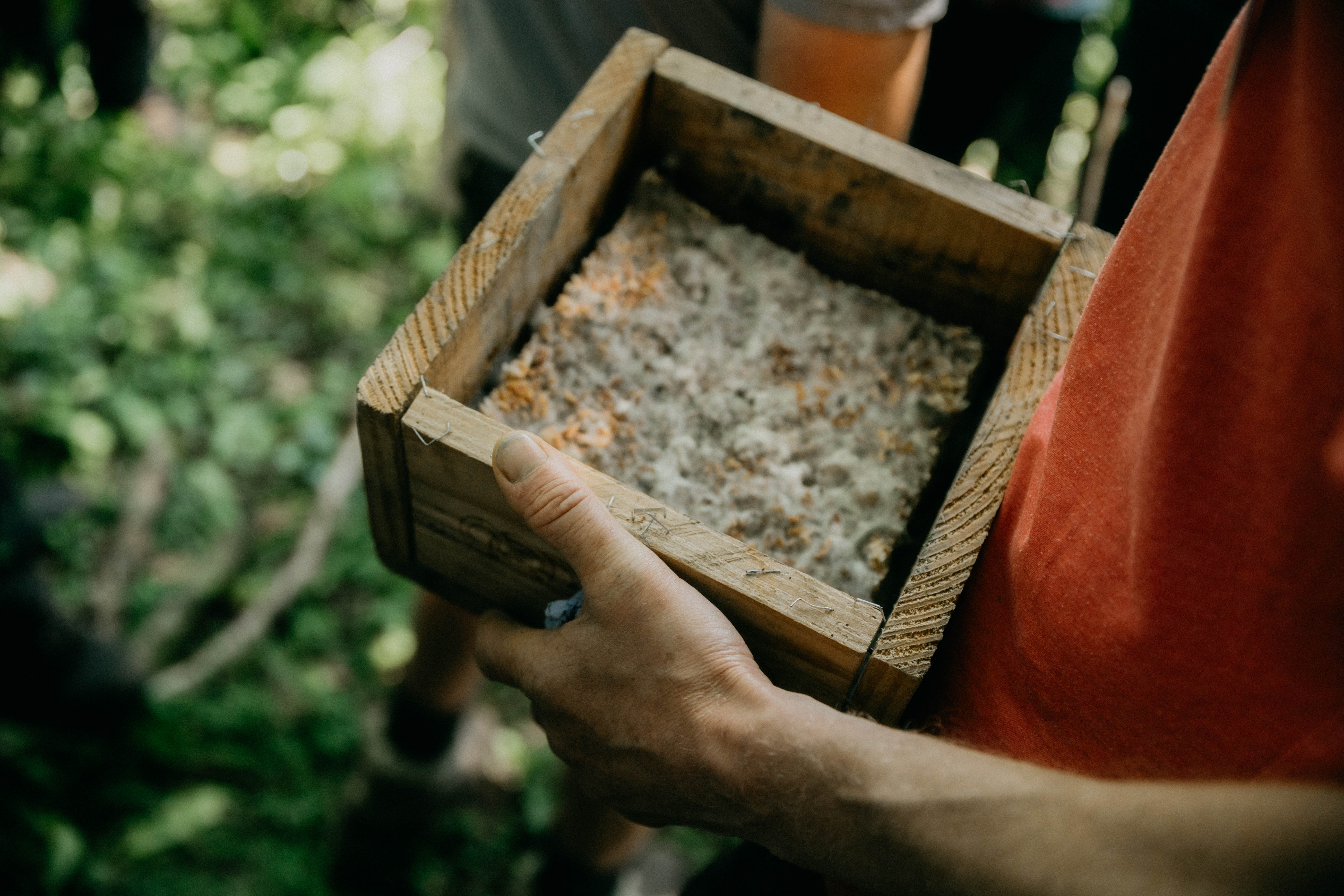
The microbes that built the soil under the forest beside your farm are already adapted to your climate, your minerals, your humidity. They will work harder than any imported microbial product. The job of the farmer is to find them, propagate them, and feed them.
Nutritive cycle theory
Plants need different nutrients at different stages of their life. A young plant pushing leaf growth needs nitrogen. A plant about to flower needs phosphorus. A plant setting fruit needs calcium and potassium. KNF aligns inputs to these stages rather than applying a constant blend year-round.
No-till agriculture
Tilling destroys the fungal networks and soil structure that healthy ground depends on. KNF works with the soil intact, feeding it from the surface and trusting earthworms, roots, and microbes to do the integration. The result is more carbon stored, less erosion, and better water retention.
Eschews synthetic chemicals
Synthetic fertilisers and pesticides damage the microbial life that the rest of the method depends on. KNF replaces them with farm-made inputs that feed soil biology rather than bypass it. This does not mean instant cessation; most farms transition gradually as natural inputs come online.
Parental love for crops
This is the principle most often misunderstood. It means observation and responsiveness. A parent does not feed a child the same meal every day. A farmer does not apply the same input regardless of weather, soil moisture, or growth stage. The crop tells you what it needs if you watch carefully enough.
The Inputs
Korean Natural Farming is a method, but underneath the recipes and the timing there is a way of thinking. These six principles shape every decision a KNF farmer makes. The inputs and stages described later in this guide only work when applied through this lens.
Microbial Inputs
These are the foundation of the method. Most KNF teachers will say roughly 80 percent of the practice is about microorganisms. Build the soil biology and everything else gets easier.
Indigenous Microorganisms
Lactic Acid Bacteria
JADAM Microbial Solution
Nutrient Solutions
These are fermented plant and animal-based liquids that supply specific nutrients at specific growth stages. They are sprayed on foliage, applied to soil, or fed to livestock in diluted form.
Fermented Plant Juice
Fermented Fruit Juice
Fish Amino Acid
Oriental Herbal Nutrient
Mineral and calcium solutions
These supply specific minerals that plants need at particular stages, often in forms that are more bioavailable than commercial alternatives.
Water-Soluble Calcium
Water-Soluble Calcium Phosphate
Brown Rice Vinegar
Seawater solution
Growth Stages
This is what separates KNF from "make some ferments and pour them on the ground". The inputs are matched to where the plant is in its life cycle. Apply the wrong input at the wrong stage and you get worse results than doing nothing. Apply the right input at the right stage and small amounts produce large effects.
Vegetative phase
The plant is building leaves, stems, and roots. The priority is rapid vegetative growth. Nitrogen is the limiting nutrient.
FPJ, FAA, IMO, LAB
Change-over period
A short transition window. The plant is shifting from vegetative growth to flowering. Phosphorus drives this change. Get the timing right and the plant flowers strongly and uniformly.
WCP, phosphoric inputs
Reproductive phase
Flowering, fruit set, and ripening. The plant needs calcium for structure, potassium for sugar transport, and stress support to bring the crop home.
WCA, FFJ, OHN, seawater
Livestock Management
KNF is not only for crops. Some of the most striking demonstrations of the method are in livestock systems, where the same microbes that build soil also transform animal welfare, odour, and waste handling. The principles are the same: feed the biology, let the biology do the work.
Cattle Dairy and Beef Systems
Piggeries
Chicken and Egg Systems
Manure and Slurry Treating the Waste Stream as a Resource
What the Method Does
These are the measurable outcomes reported by KNF farmers across multiple countries and decades. The numbers below come from farms running KNF as a complete system, not from one-off input trials. Results in Ireland are still being documented, and we will publish those findings as they come in.
Healthier soil holds more water and crops need less irrigation in dry periods.
Farm-made inputs cost a fraction of synthetic fertilisers and reduce dependency over time.
Compounding gains in organic matter and carbon year over year.
Lorem ipsum dolor sit amet, consectetur adipiscing elit.
Lorem ipsum dolor sit amet, consectetur adipiscing elit.
Lineage
KNF was developed by Master Cho Han-Kyu in Korea from the 1960s onward. His son Youngsang Cho later developed JADAM, a faster, more accessible variant of the method. Chris Trump scaled KNF on a macadamia farm in Hawaii and became the main English-language teacher of the method. Dr. Jung Park introduced KNF to Hawaii's commercial agriculture sector. The full story of how the method travelled is on the Origins page.
Read the full story.